Welcome to my Kuala Lumpur

This is my way of sharing my discoveries, re-discoveries, memories & experiences

as well as other bits & pieces of information I have of

growing up in Kuala Lumpur.

Your comments & suggestions to make this blog your reference to all things KL would be very much appreciated.

Search This Blog

Showing posts with label Brickfields. Show all posts

Thursday, November 4, 2010

Brickfields Revisited - Toddy Shop

When I did my postings on Brickfields earlier, I thought that I had covered a good portion of the area.  As I was not aware of a toddy shop being there, I was surprised at a recent news paper report that the toddy shop is to be demolished to make way for development.  While at Brickfields, I thought I'd check it out.  I did have to ask for directions though.
The toddy shop is a little nondescript place at one end of Jalan Berhala.
I have passed here a number of times on my walk about, but as the place only opens at 10.30 a.m. I didn't notice it before.  The building looks similar to the one in Chow Kit that was around many years ago.
This is a Government Toddy Shop i.e. not just licensed, but owned and operated by the Customs' Department, a relic of our colonial past.
By the way operating hours are between 10.30 a.m. and 5.00 p.m., so don't think of trying this place for some late night boozing session.
The furniture consists only of long wooden benches and table.
I suppose if regular chairs were provided, it would be easier to throw them at each other. (I know I'm being judgmental here, but hey, I'm no saint.)
Serving utensils are only plastic mugs.
I recall that in those days in Chow Kit, there used to be some enterprising people who used to rent out enamel mugs of various sizes.  The owners' sign and the rental price (5c, 10c etc) used to be painted prominently on the mugs.  Business was brisk during the evenings and every morning they had to pick up the mugs belonging to them 
There is a little temple attached to this toddy shop.
The sign says that it is the Sree Maha Kaliamman Kovil, Kuala Lumpur.

The temple is dedicated to the Goddess Kali.

It is interesting to note that some toddy is offered to the guardian deities there before the shop commences for business for the day.

Toddy is made from the sap of that oozes from the coconut inflorescence and is allowed to ferment naturally.  There is no distillation process involved.  Click here and here for some interesting photos.

Toddy is cheap, about RM1 per liter,  cheaper than what plain iced water (ais kosong) costs in some restaurants and definitely much cheaper than bottled water.  Is it any wonder then that it is the poor man's alcoholic drink of choice.


Wednesday, November 3, 2010

Brickfields Revisited - Little India

When talking of 'Little India' in KL, the Jalan Masjid India area comes to mind. Maybe we can include Lebuh Ampang as well.


However, of late, there has been a lot of fuss about Brickfields being 'Little India'. There is a sizable Tamil population in the Brickfields area, but that is also true of Sentul and there are 'Indian' settlements in Kampung Pandan, Air Panas and Selayang/Batu Caves areas among others.


Anyway, its been a while since I've been to Brickfields, so I decided to pay the place a visit.


Although, the Prime Minister of India has already visited and officiated the area together with our own Prime Minister, the area still seems very much a 'work-in-progress'.
Large designs representing 'kolams' have been painted on the roads.
Kolams are usually done in front of Hindu homes especially in South India.  It is traditionally done using course ground rice flour and provides food for ants, birds and other small creatures.
Street lights have been changed.
A contemporary sculpture of a traditional dancer has been erected there - probably symbolic of embracing modernity while holding on to our culture and traditions. 
A fountain with Indian motifs has been placed at the junction of Jalan Travers and Jalan Tun Sambanthan.
Colorful arches have been erected along part of the road.
Personally, I think that these are a waste of money and will soon turn into an eyesore with bills and posters plastered on them and unlicensed traders using them to display their wares.
This restaurant is being renovated to give it the 'ethnic' look.
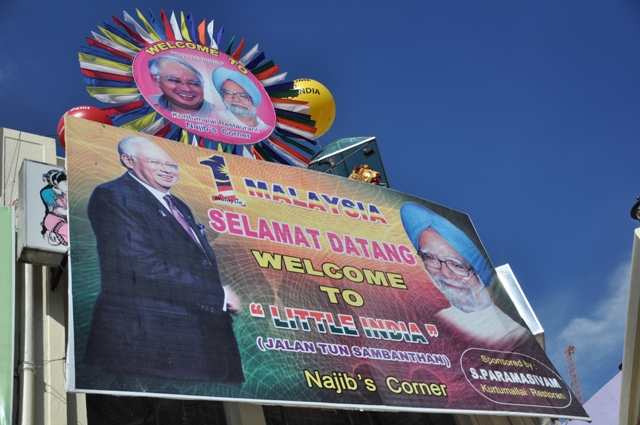
Businessmen are quick to capitalize on a good thing.  This is now 'Najib's Corner'.
I chanced upon this lorry delivering banana leaves to the many restaurants here and elsewhere.  Looking at this load, there must be large plantations to provide these quantity of leaves daily.


The Global Indian International School is along Lorong Abdul Samad.  I seem to have missed this school during my earlier post.
The GIIS is established by the Global Indian Foundation, a Singapore based non-profit foundation.  Click here for their website.
I was wondering why these two Catholic Chinese schools have not merged as one when they operated from the same premises.  Then I realized that one is a girls' school while the other is all boys. 
I saw this Malay styled wooden house at the end of Jalan Berhala near the Buddhist Vihara. 
The Nepali guard stationed there was unable to provide any information on the property except to say that the building is currently unoccupied.


Friday, November 20, 2009

Buddhist Maha Vihara, Brickfields


No account of Brickfields will be complete without mention of the Buddhist Temple here.  The temple or Vihara celebrated its 100th anniversary in 1995, which makes it 114 years old now.

The Centenary Celebration booklet mentions that the Sasana Abhiwurdhi Wardana Society was born out of hardship, perseverance and confidence to make it what it is today.

In the late 19th century a group of 87 Sinhalese applied to the then British Resident, W H Treacher to grant them a parcel of land to build a temple to practice their faith and to bring down from Ceylon a number of monks for the propagation of Buddhism.

 
When the lotus flower is depicted on the pavements and street lights, you know that you are on the right track to the Buddhist Maha Vihara.


The lotus fountain welcomes all devotees and visitors as we go through the main entrance.


The Shrine Hall is currently undergoing renovations.


This looks like an Ashoka Pillar.

Ashoka ascended to the throne in 269 BCE inheriting the empire founded by his grandfather Chandragupta Maurya. Ashoka was reputedly a tyrant at the outset of his reign. Eight years after his accession he campaigned in Kalinga where in his own words, "a hundred and fifty thousand people were deported, a hundred thousand were killed and as many as that perished..." After this event Ashoka converted to Buddhism in remorse for the loss of life. Buddhism didn't become a state religion but with Ashoka's support it spread rapidly. The inscriptions on the pillars described edicts about morality based on Buddhist tenets. Legend has it that Ashoka built 84,000 Stupas commemorating the events and relics of Buddha's life. Some of these Stupas contained networks of walls containing the hub spokes and rim of a wheel, while others contained interior walls in a swastika shape. The wheel represents the sun, time, and Buddhist law (the wheel of law, or dharmachakra), while the swastika stands for the cosmic dance around a fixed center and guards against evil.
(Wikipedia)

 
The inscriptions on the pillar.


While generally, this temple complex has a lot of Sinhala influence, other cultures also seem to play a part here like this Chinese lion.


The International Pagoda.
 

Some religions service is taking place inside of the Pagoda.
 

Tun Tan Siew Sin, was also the president of the MCA (Malaysian Chinese Association) then.  He is the son of Tun Tan Cheng Lock, founder of MCA.


The temple is not only about the spiritual well-being of devotees but also about providing education for their worldly well-being.
 

And so ends my walk around the Brickfields area.